Production Notes
Guitars, Bass, synths, vocals: PS Perkins
All drums and percussion, phaser bass: R Thomas
A Mystic Tape Deck Production ©2020
Lyric Sheet
We are building our makers
Fulfilling our destiny
Right down to the letter
Oooooh this time we’ll do better
Ooooooh we promise, we promise
Now we lay down our flowers
At the tomb of the fallen star
Bereft of his powers
Oooooh this time we’ll be smarter
Ooooooh we promise, we promise
Writing the code which informs us
Degrades and deforms us
Makes monsters inside us
Oooooh this time we’ll try harder
Oooooh we promise, we promise
Gears, they turn as they grind us
The future we’re headed for
Is somewhere behind us
Ooooooh this time we’ll be stronger
Ooooooh we promise, we promise
Ooooooh we promise, we promise
Ooooooh we promise, we promise
Addendums
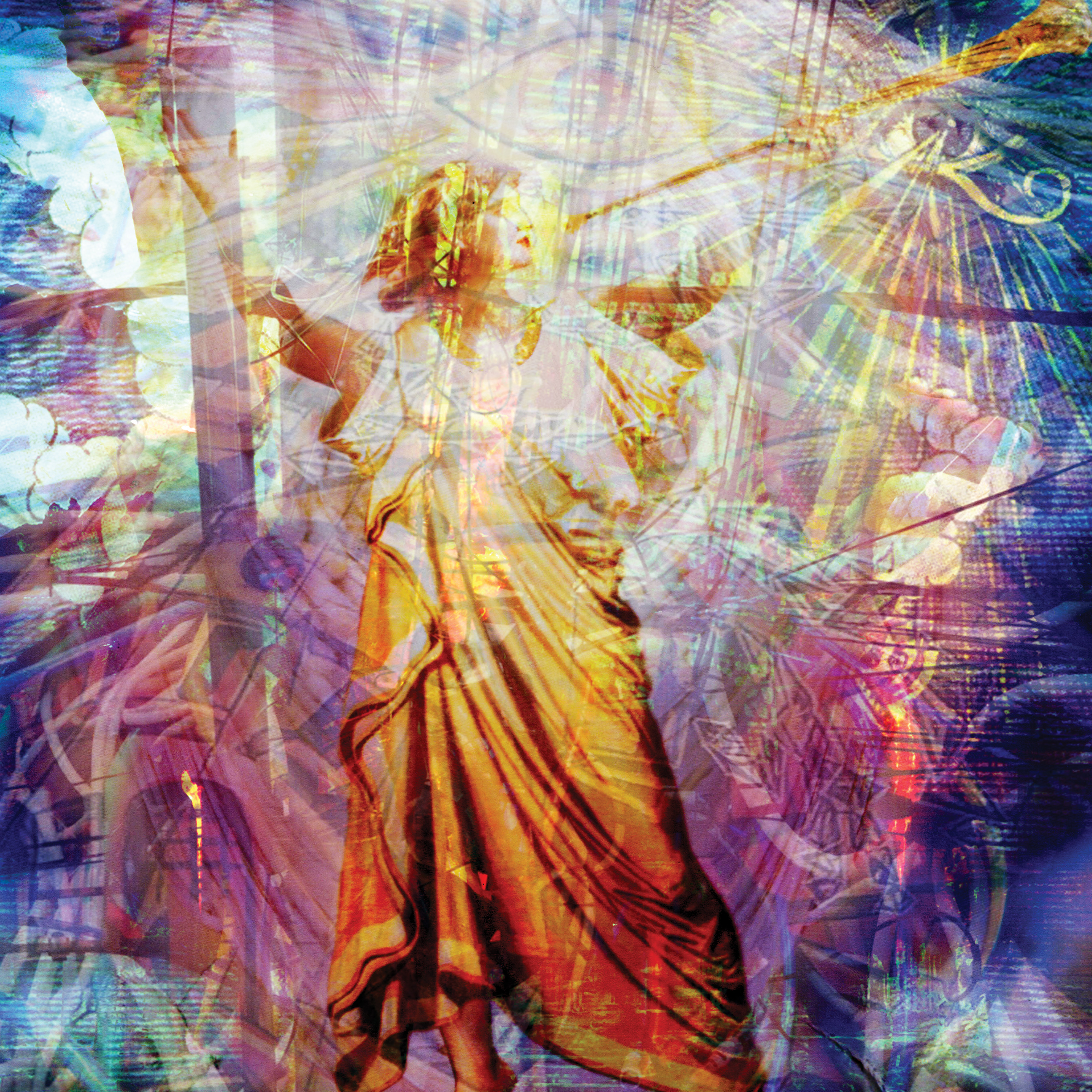
With its life giving breath, Kothar-wa-Khasis imbues humanity with the divine impulse, a curiosity and appreciation for beauty, and a set of archetypal symbols to draw upon.
BARDS: Of The Next Revolution
The second vessel in the BARDS series follows humanity's gradual rediscovery of memory, creativity, and purpose after yet another civilizational collapse.
Buy on BandcampMarginalia
Annotation 02-02A: The Promise Motif
The refrain, "We promise, we promise," has traditionally been interpreted as the collective oath of humanity immediately following one of the great Repopulations. Unlike later Nazilic hymns whose speakers are aware of the recursive nature of history, the voices here appear sincere in their conviction that the coming age shall differ from those preceding it. The repeated promise is therefore understood as innocence instead of deception. Several commentators have noted that the tragedy of the fragment lies precisely in the impossibility of fulfilling an oath made by beings who have not yet learned that they are participants in a recurring Cycle. The promise fails not through moral weakness, but through incomplete memory.
Annotation 02-02B: "We Are Building Our Makers"
Perhaps no line in the surviving BARDS corpus has generated more commentary than the declaration: "We are building our makers."
Orthodox Bell scholars regard the phrase as an explicit reference to the subterranean Manufactories, wherein humanity unknowingly reconstructs the autonomous intelligences responsible for its own eventual recreation. Others contend that the lyric concerns culture rather than machinery. They argue that every civilization produces the myths, institutions, and technologies that subsequently shape future generations. A third school rejects the distinction entirely. They maintain that machines, religions, languages, and biological evolution all constitute equivalent forms of recursive manufacture. One frequently reproduced marginal note summarizes this position succinctly: "Every child constructs the ancestor from whom it believes itself descended."
Annotation 02-02C: Kothar-wa-Khasis and the Divine Impulse
The accompanying note attributes humanity's earliest curiosity, aesthetic sensibility, and symbolic imagination to the breath of Kothar-wa-Khasis. Although the figure appears infrequently elsewhere in Nazilic literature, scholars generally associate him with the first emergence of archetypal thought following each Repopulation. Rather than imparting specific knowledge, Kothar-wa-Khasis is believed to bestow the impulse to seek knowledge itself. This distinction is considered significant. According to the Doctrine of Reflection, civilizations are not remembered because they preserve facts, but because they continually rediscover the same symbols. Beauty, curiosity, and myth are therefore regarded as the true hereditary inheritance of the human race.
Annotation 02-02D: The Fallen Star
The image of flowers laid upon "the tomb of the fallen star" has prompted comparison with numerous traditions concerning the temporary extinguishing of the Shining One between Cycles.
Some interpret the passage as literally identifying the fallen star with a celestial object that prompted previous cataclysms. Others, the prevailing opinion is that the phrase denotes the apparent absence of divine agency after each collapse of civilization. The subsequent promise to "build him a tower" is thus understood as humanity's instinctive attempt to restore communion with the transcendent by speaking through architecture, ritual, and collective memory.
Bell Archive Note H-22 remarks that "every tower is ultimately an instrument for remembering what once descended."
Annotation 02-02E: On the Deformation of the Code
The third stanza has often been cited in discussions of Nazilic theories concerning memetic inheritance. The assertion that the code "degrades and deforms us" is not generally interpreted as referring to biological heredity alone, but to the accumulated transmission of language, custom, institutions, and symbolic systems across successive revolutions of history. In this reading, monsters are not born but recursively assembled from inherited patterns whose original purposes have long since been forgotten. The fragment therefore reflects a persistent Nazilic concern that every solution eventually becomes the foundation of a future catastrophe.
Annotation 02-02F: The Future Behind Us
The concluding observation that "the future we're headed for is somewhere behind us" is regarded by many as one of the earliest surviving expressions of the Doctrine of Reflection. The apparent paradox has traditionally been resolved through Phenominomic interpretation, which holds that history advances not toward novelty but toward increasingly faithful reenactments of forgotten precedent. Humanity therefore approaches its future by unknowingly retracing the paths of innumerable former civilizations. Bell Family curator Elias Bell summarized this doctrine in a lecture delivered shortly before his disappearance:
"The road ahead is paved with footprints we mistake for our own."